
A2 Level Physics (9702): Notes, Past Papers & Online Classes
Everything you need for A2 Physics in one place — free topic notes, a paper-by-paper strategy for Paper 4 and Paper 5, past-paper technique, and structured online classes taught by Sir Mahad Amer.
What this page covers
What is A2 Level Physics?
A2 Level Physics is the second year of Cambridge International A Level
Physics, syllabus code 9702. It builds directly on the AS year and adds
substantially more mathematical depth — gravitational and electric fields,
oscillations, capacitance, quantum physics and nuclear physics all appear
for the first time at this stage.
The step up from AS to A2 catches many students by surprise. AS rewards
careful, precise work on relatively familiar mechanics and electricity. A2
asks you to handle abstract field concepts, exponential relationships and
multi-step reasoning — and it assumes your AS foundations are
completely secure.
A2 Physics 9702 at a glance
- Syllabus code: 9702 (Cambridge International A Level Physics)
- Papers sat in A2: Paper 4 (structured) and Paper 5 (planning, analysis and evaluation)
- Topics: 13 chapters, from circular motion to astronomy and cosmology
- Assumed knowledge: the complete AS syllabus
- Exam sessions: May/June and October/November
Full A2 Level Physics topic list
Below is the complete A2 content of the 9702 syllabus, with the key ideas each chapter is really testing. Free topic notes for every one of these are available on our A2 Level Physics notes page.
| Topic | What it actually tests |
|---|---|
| Circular Motion | Angular velocity, centripetal acceleration and the fact that a resultant force can change direction without changing speed. |
| Gravitational Fields | Newton's law of gravitation, field strength vs potential, and orbital mechanics including geostationary satellites. |
| Thermal Physics | Ideal gas equation, kinetic theory, internal energy and the first law of thermodynamics with correct sign conventions. |
| Oscillations | Simple harmonic motion, the a = −ω²x relationship, energy in SHM, damping and resonance. |
| Electric Fields | Coulomb's law, field strength and potential, and the constant parallels with gravitational fields. |
| Capacitance | Charge storage, series and parallel combinations, energy stored, and exponential charge/discharge. |
| Magnetic Fields | Force on current-carrying conductors and moving charges, Fleming's left-hand rule, velocity selectors. |
| Electromagnetic Induction | Faraday's and Lenz's laws, flux linkage, and explaining induced e.m.f. in words that earn marks. |
| Alternating Current | Peak vs r.m.s. values, rectification, and smoothing with capacitors. |
| Quantum Physics | Photoelectric effect, wave–particle duality, energy levels and line spectra. |
| Nuclear Physics | Mass defect, binding energy per nucleon, and radioactive decay as an exponential process. |
| Medical Physics | Ultrasound, X-ray production and attenuation, and the principles behind MRI. |
| Astronomy & Cosmology | Standard candles, Hubble's law, redshift and the expanding universe. |
Paper 4 and Paper 5 explained
In the A2 year you sit two papers. Understanding what each one actually rewards is the fastest way to lift your grade.
| Paper | What it is | What it rewards |
|---|---|---|
| Paper 4 | Structured questions on the full A2 content, with AS knowledge assumed throughout. | Precise definitions, clear working line by line, correct units and confident algebra. |
| Paper 5 | Planning, analysis and evaluation. No recall of A2 content is required. | A repeatable method: identify variables, describe procedure, tabulate, linearise, plot, evaluate. |
Important: Paper 5 does not test how much physics you know. It tests whether you can design and analyse an experiment properly. That means it is trainable in a way Paper 4 is not — and it is where the largest number of easy marks sit.
Which A2 topics do students find hardest?
After teaching A2 Physics for several years, the same four topics come up again and again in doubt-solving sessions:
1. Fields (gravitational and electric)
The difficulty is conceptual, not mathematical. Students confuse field strength (force per unit mass or charge, a vector) with potential (energy per unit mass or charge, a scalar). Once you learn the two field types side by side and notice that the equations mirror each other almost exactly, this topic becomes one of the most predictable in the paper.
2. Capacitor discharge and exponentials
Exponential decay appears in capacitance and again in radioactivity. Students who are comfortable rearranging exponential equations and taking natural logs handle both topics easily; those who are not lose marks twice.
3. Simple harmonic motion
SHM questions are highly graphical. Sketching displacement, velocity and acceleration against time — and understanding the phase relationships between them — solves most of the questions before any calculation begins.
4. Explaining electromagnetic induction in words
Calculations here are usually straightforward. The marks are lost on the written explanation, because Cambridge expects a specific chain of reasoning: flux linkage changes → rate of change of flux linkage induces e.m.f. → induced current opposes the change causing it.
How to score an A* in A2 Physics
The gap between an A and an A* in 9702 is rarely raw ability. It comes down to three habits.
- 1
Learn definitions word-perfect
Cambridge awards marks for specific wording. "Gravitational potential at a point is the work done per unit mass in bringing a small test mass from infinity to that point" earns full marks; a rough paraphrase often earns none. Write definitions from memory, then check against the syllabus.
- 2
Show every line of working
Method marks are generous. A student who reaches the wrong final answer with clear, correct working typically scores far more than one who writes only a wrong answer. Never do multi-step algebra in your head.
- 3
Drill Paper 5 separately
Treat it as its own subject with its own weekly practice. Because its structure repeats every session, focused practice here reliably converts into marks — see the section below.
Paper 5: the biggest easy win in A2 Physics
Paper 5 follows a near-identical structure every session, which makes it the single most improvable paper in the qualification. Almost every planning question can be answered with this framework:
- 1
Identify the variables
State the independent variable, the dependent variable, and at least two variables to keep constant. Marks are awarded for each.
- 2
Describe the method
Explain what you will measure and with what instrument. Be specific: "measure the diameter with a micrometer screw gauge", not "measure the diameter".
- 3
Linearise the relationship
Rearrange the suggested equation into the form y = mx + c so that a straight-line graph can be plotted. This is where the analysis marks concentrate.
- 4
Plan the graph
State exactly what you will plot on each axis and what the gradient and intercept will represent physically.
- 5
Add safety and improvements
Give one genuine, relevant safety precaution and two sensible improvements. Generic answers such as "be careful" score nothing.
7 mistakes that cost A2 Physics students mark
- Mixing up field strength and potential. —One is a vector measured in N/kg or N/C; the other is a scalar measured in J/kg or volts.
- Dropping the negative sign in gravitational potential and in Lenz’s law.
- Using peak instead of r.m.s. values in a.c. power calculations.
- Forgetting that “per unit mass” or “per unit charge” must appear in field and potential definitions
- Rounding too early in multi-step calculations, then losing the final accuracy mark.
- Writing vague explanations such as the field gets weaker” instead of stating the inverse-square relationship explicitly.
- Never practising Paper 5 under timed conditions, then running out of time in the real exam
A realistic A2 Physics study plan
This is the plan we use with students across a full A2 academic year. It works because it pairs learning with immediate practice rather than saving all past papers for the end.
| Stage | Focus | Practice |
|---|---|---|
| Term 1 | Circular motion, gravitational fields, thermal physics, oscillations | Topical past-paper questions immediately after each chapter |
| Term 2 | Electric fields, capacitance, magnetic fields, induction, a.c. | Topical questions + begin weekly Paper 5 practice |
| Term 3 | Quantum, nuclear, medical physics, astronomy | Mixed-topic questions; start full timed Paper 4s |
| Final 8 weeks | Revision of weak topics from your error log | One full Paper 4 and one Paper 5 per week, self-marked |
The error log habit: after every past paper, write down each mistake and its cause — concept gap, careless slip, or misread question. Reattempt those exact questions a week later. Students who keep an honest error log improve noticeably faster than those who simply do more papers
A2 Physics classes with Sir Mahad Amer
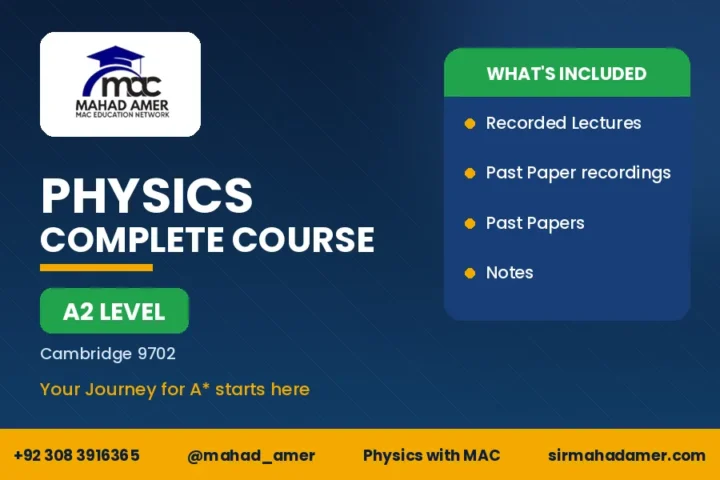
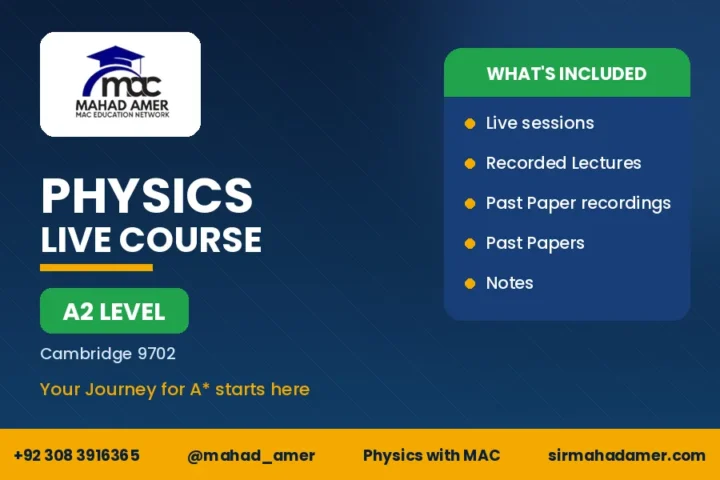
If you want structured teaching rather than self-study, our A2 courses cover the entire 9702 A2 syllabus with recorded lectures, topic notes, past-paper solutions and doubt-solving support. Classes are online, so students join from Karachi, Lahore, Islamabad and across Pakistan, as well as from overseas.
 A2 Level
Related pages
From classroom learning to exam success
A structured system built around concept clarity and past-paper mastery
◆ Strong Concept Clarity
Every topic broken down from first principles so the ideas actually stick.
◆ Past-Paper Mastery
Structured past-paper drills that build real exam confidence and speed.
◆ Comprehensive Notes
Topic-wise notes and summaries aligned to the Cambridge syllabus.
A2 Level Physics FAQs
Is A2 Physics harder than AS?
Yes, in two specific ways. The mathematics steps up — exponentials, logarithms and field equations appear throughout — and A2 assumes your AS content is completely secure. Students who genuinely understood AS usually cope well; those who memorised AS tend to
struggle, because A2 keeps asking them to apply the earlier ideas in
new contexts.
What is Paper 5 in A2 Physics?
Paper 5 is the planning, analysis and evaluation paper. It does not test recall of A2 topics — instead you design an experiment, decide what to measure, linearise a relationship into y = mx + c, plan a graph and evaluate the method. Because its structure repeats every session, it
responds extremely well to focused practice and is often where students gain the most marks.
Which A2 Physics topics are the hardest?
Most students find gravitational and electric fields, capacitor discharge,
simple harmonic motion, and written explanations of electromagnetic induction the most difficult. Fields and capacitance are conceptual rather than mathematical problems — once the distinction between field strength and potential is clear, both become predictable.
Do A2 Physics notes cover the whole syllabus?
Yes. Our free A2 Level Physics notes cover all 13 A2 chapters of the Cambridge 9702 syllabus, including medical physics, astronomy and cosmology, plus a dedicated section on Paper 5 skills.
Can I join A2 classes if my AS grade was weak?
Yes. The A2 course revisits the AS foundations that A2 depends on — particularly mechanics, energy and electricity — before building the advanced topics on top. Many students who found AS difficult go on to do well at A2 once the underlying concepts are properly rebuilt.
How many past papers should I do for A2 Physics?
Aim for at least the last five years of Paper 4 and Paper 5, attempted properly: timed, self-marked against the official mark scheme, with every mistake logged and re-attempted a week later. Five papers done this way is worth far more than fifteen done carelessly.
Are the A2 classes online or in person?
All classes are delivered online, so students from any city in Pakistan — Karachi, Lahore, Islamabad, Rawalpindi, Faisalabad, Multan, Peshawar — as well as students overseas can join. Every live session is recorded, so you can revise any explanation as many times as you need.