
O Level & IGCSE Physics (5054 & 0625)
Everything for Cambridge O Level and IGCSE Physics in one place — complete topic list, paper structure, the habits that earn an A*, and a 30-day revision plan.
O Level Physics (5054) vs IGCSE Physics (0625)
O Level Physics (5054) and IGCSE Physics (0625) are both Cambridge qualifications taken at the same stage, and they share the overwhelming majority of their content. The physics you learn is largely identical — what differs is the assessment structure.
| O Level Physics 5054 | IGCSE Physics 0625 | |
|---|---|---|
| Tiering | Single tier | Core and Extended tiers |
| Practical assessment | Practical test or alternative | Paper 5 (practical) or Paper 6 (Alternative to Practical) |
| Top grade available | A* | A* (Extended tier only) |
| Typically chosen by | Schools following the O Level route | Schools following the international IGCSE route |
Which should you take? In practice most students do not choose — the school decides. If yours offers both and you are targeting an A*, make sure you are entered for Extended IGCSE rather than Core, because Core caps the maximum grade available.
Complete O Level & IGCSE Physics topic list
Free topic-wise notes for every chapter below are available on our O Level & IGCSE Physics notes page.
| Topic | Key ideas examined |
|---|---|
| Kinematics | Speed, velocity, acceleration, and interpreting distance-time and speed-time graphs. |
| Forces | Newton's laws, resultant forces, friction, and free-body diagrams. |
| Moments | The turning effect of forces, principle of moments, and conditions for equilibrium. |
| Pressure | Pressure in solids and liquids, the p = hρg relationship, and manometers. |
| Work, Energy & Power | Energy stores and transfers, conservation of energy, efficiency calculations. |
| Momentum | Conservation of momentum in collisions and explosions. |
| Thermal Physics | Kinetic model, conduction, convection, radiation, and specific heat capacity. |
| Waves | Transverse and longitudinal waves, reflection, refraction and the wave equation. |
| Light & Lenses | Ray diagrams, refraction, total internal reflection and image formation. |
| Sound | Production, transmission, echoes and the speed of sound. |
| Electromagnetic Spectrum | Order of the spectrum, properties and uses of each region. |
| Electrical Quantities | Charge, current, potential difference, resistance and electrical energy. |
| Current Electricity | Series and parallel circuits, circuit components and calculations. |
| Magnetism | Magnetic fields, magnetisation and the motor effect. |
| Electromagnetic Induction | Generators, transformers and induced e.m.f. |
| Nuclear Physics | Atomic structure, radioactive decay, half-life and safety. |
Paper structure
Both syllabuses assess through a combination of multiple-choice,
structured written questions and practical skills. The precise paper
numbering differs, so always check the current syllabus document for the
session you are sitting — Cambridge occasionally updates the structure.
What does not change is what earns marks: precise definitions, clear
diagrams, visible working and correct units.
Paper 6: Alternative to Practical (IGCSE)
For IGCSE students who do not sit the laboratory practical, Paper 6 tests experimental understanding in written form. It is one of the most improvable papers in the qualification because it rewards technique rather than knowledge.
- Reading instruments correctly — including scale divisions and zero errors.
- Recording data consistently — same number of decimal places throughout a column.
- Table headings with units — a frequent and entirely avoidable loss of marks.
- Large, well-scaled graphs — plotted points should fill more than half the grid.
- Identifying genuine sources of error — specific to the experiment, not generic statements.
- Suggesting realistic improvements — “repeat and average” alone rarely earns full credit.
Where students lose easy marks
At this level, marks are rarely lost on difficult reasoning. They are lost on avoidable habits:
- Definitions written approximately instead of in the exact syllabus wording.
- Missing units on final answers, table headings or graph axes.
- Ray and circuit diagrams drawn freehand instead of with a ruler
- Graphs drawn too small to plot accurately.
- Answering “explain” with a bare calculation and no reasoning.
- Ignoring mark allocation — a 4-mark question requires four separate scoring points.
The four habits that earn an A*
- 1
Learn definitions word-perfect
Not the idea — the exact statement. This is the cheapest source of marks in the entire paper and the one students most often neglect.
- 2
Draw with a ruler, always
Ray diagrams, circuit diagrams and graphs carry straightforward marks that untidy work throws away.
- 3
Show every step of working
Method marks are available even when the final answer is wrong, but only if the examiner can see your reasoning.
- 4
Check units before moving on
It takes seconds per question and saves marks in every single paper.
A 30-day revision plan
| Days | Focus | Daily target |
|---|---|---|
| 1-15 | One topic per day; read notes, then do topical past-paper questions on it | 1 topic + 1 topical question set |
| 16-25 | Full past papers under timed conditions, marked honestly against mark schemes | 1 paper every 2 days + same-day marking |
| 26-30 | Error log only: re-attempt every logged mistake, review definitions and formulas | No new papers — consolidate |
For the full method behind step two, see our guide to O Level Physics past papers.
O Level & IGCSE Physics classes with Sir Mahad Amer
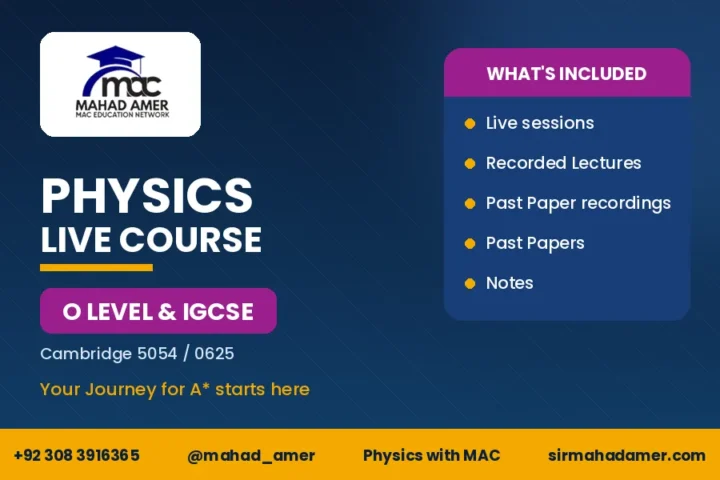
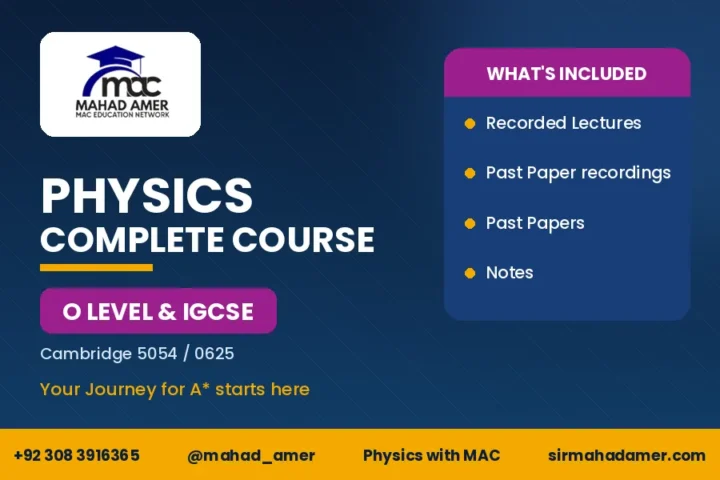
Our courses cover both the 5054 and 0625 syllabuses together, with syllabus-specific guidance where they differ — including Paper 6 technique for IGCSE students. All classes are online, so students join from across Pakistan and overseas
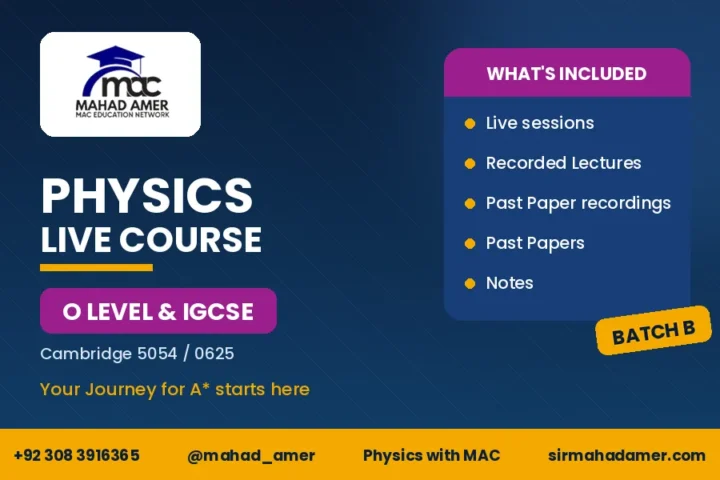
 Live Session (O-Level)
Related pages
From classroom learning to exam success
A structured system built around concept clarity and past-paper mastery
◆ Strong Concept Clarity
Every topic broken down from first principles so the ideas actually stick.
◆ Past-Paper Mastery
Structured past-paper drills that build real exam confidence and speed.
◆ Comprehensive Notes
Topic-wise notes and summaries aligned to the Cambridge syllabus.
O Level & IGCSE Physics FAQs
What is the difference between O Level 5054 and IGCSE 0625 Physics?
They cover very similar physics and sit at the same level. IGCSE 0625
has Core and Extended tiers plus an Alternative to Practical paper; O
Level 5054 uses a single tier with its own paper structure. Your school
usually decides which you sit.
Which is harder, O Level or IGCSE Physics?
Neither is clearly harder. Extended IGCSE and O Level are comparable in
demand and the content overlaps heavily. If you are targeting an A*, the
important thing is being entered for Extended rather than Core in IGCSE.
What is Paper 6 in IGCSE Physics?
Paper 6 is the Alternative to Practical, which tests experimental
understanding in written form instead of in a laboratory. It rewards
technique — reading instruments, tabulating data, plotting large graphs
and identifying specific sources of error — so it improves quickly with
practice.
Where do students lose the most marks?
Rarely on hard physics. The recurring losses are imprecise definitions,
missing units, freehand diagrams and graphs drawn too small. Fixing
those four habits alone typically moves a student up a grade.
How long before the exam should I start revising?
Serious revision should begin at least two to three months out, with
topical past-paper questions running alongside the syllabus throughout
the year rather than saved until the end.
Do I need to memorise formulas for O Level and IGCSE Physics?
Cambridge provides some formulas, but you should know the common
ones fluently so you are not slowed down in the exam. Note that
Pearson Edexcel requires noticeably more formula recall from memory
than Cambridge does.
Are classes available for students outside Karachi?
Yes. All classes are online, so students in Lahore, Islamabad, Rawalpindi,
Faisalabad, Multan, Peshawar and any other city in Pakistan can join, as
can students studying overseas. Sessions are recorded for revision.