A Level Physics (9702): The Complete Guide to Getting an A*

ARTICLE
Cambridge A Level Physics — syllabus 9702 — is one of the most respected school qualifications in the world, and one of the most demanding. This guide walks through how the qualification is structured, what each paper rewards, and the specific habits that separate an A from an A*.
How Cambridge 9702 is structured
A Level Physics 9702 runs across two years. The AS year covers the foundations: measurement, kinematics, dynamics, energy, materials, waves, superposition and electricity. The A2 year adds circular motion, fields, oscillations, capacitance, quantum physics and nuclear physics, plus medical physics and astronomy.
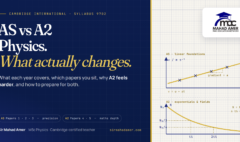
The two years are covered in detail on our dedicated pages for AS Level Physics and A2 Level Physics. If you are unsure how the two halves differ, our guide on AS vs A2 Physics breaks it down.
| Paper | Content | Format |
|---|---|---|
| Paper 1 | AS content | Multiple choice |
| Paper 2 | AS content | Structured questions |
| Paper 3 | AS practical skills | Laboratory practical |
| Paper 4 | A2 content | Structured questions |
| Paper 5 | Planning, analysis, evaluation | Skills-based written paper |
Paper-by-paper strategy
Paper 1
Speed and precision. The traps are usually unit errors and sign conventions rather than difficult physics. Practise until you can eliminate wrong options quickly, and never leave a multiple-choice question blank — an educated guess has a one-in-four chance.
Paper 2 and Paper 4
Marks live in the wording. Learn definitions word-perfect, show working line by line, and always carry units through. Partial credit is generous if your method is visible, so never do multi-step algebra in your head.
Paper 3
The practical paper rewards technique you can rehearse: reading instruments correctly, recording data to consistent significant figures, drawing large clear graphs and evaluating genuine sources of error.
What separates an A from an A*
Three things, and none of them is raw talent:
- Precise mark-scheme language rather than approximate explanations. Cambridge awards marks for specific words.
- Confident mathematics — especially exponentials, logarithms and field equations, which appear throughout A2.
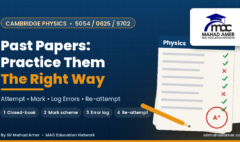
- Consistent timed past-paper practice from early in the year rather than a panic in the final month.
💡 Consistent timed past-paper practice from early in the year rather than a panic in the final month.
A realistic study plan
Step 1: Learn each topic properly before moving on
Physics compounds — gaps in AS make A2 much harder, so keeping up matters more than raw ability.
Step 2: Do topical past-paper questions immediately
After each chapter, attempt past-paper questions on that chapter the same week while the concept is fresh.
Step 3: Switch to full timed papers three months out
Build exam stamina and pacing by sitting complete papers under timed conditions weekly.
Step 4: Maintain an error log
Record every mistake and its cause, then revisit it before every mock. This single habit reliably separates students who improve from those who plateau.
How much maths do you really need?
You need confident algebra, trigonometry, graph work, logarithms and exponentials. You do not need to be studying Further Mathematics — but you do need to be fluent, because A2 in particular assumes you can rearrange exponential equations and handle field relationships without hesitation.
For the full method behind past-paper practice, see our pillar guide on Cambridge Physics past papers
Frequently Asked Questions
Is A Level Physics 9702 hard?
It is demanding but very learnable. The main challenge is that content compounds — gaps in AS make A2 much harder, so keeping up matters more than raw ability.
How much maths do I need for A Level Physics?
Confident algebra, trigonometry, graph work, logarithms and exponentials. You do not need Further Mathematics, but you must be fluent enough to handle A2 field and exponential equations without hesitation.
Which paper do students lose most marks on?
Paper 5 is where many students underperform, mostly because they never practise it specifically — despite it being highly predictable in structure.
How early should I start preparing for an A*?
From the first term. Students who build the past-paper habit early consistently outperform those who cram late.
Do AS marks count towards the final A Level grade?
Yes. AS results contribute to the overall A Level grade, so a strong AS year makes the A* target much more achievable.
Author byline: Sir Mahad Amer — Cambridge-certified Physics teacher, MSc Physics, founder of MAC Education Network.